Studio Journal – Exploring Light Sculpture & Steel
Inside the Sype Design workshop: artistic inspiration, steel craftsmanship and sculptural lightning.
Discover the creative world of Sype Design through its studio journal. From early ideas and experiments with raw steel to finished light sculptures and illuminated mirrors, explore the artistic process behind each creation.
An invitation to discover how contemporary light art, metal craftsmanship and the exploration of light come together in the workshop of a French artist.
Studio Journal
01
The Creative Process Behind Steel Light Sculptures
Step inside the creative process behind my handcrafted steel light sculptures, where artistic intuition meets traditional metal craftsmanship.
Around 30% of my ideas begin with discarded pieces of steel discovered in the workshop. Another 50% emerge while I am creating a different sculpture, as unexpected shapes and compositions reveal new possibilities.
The remaining 20% are inspired by travel, architecture, encounters and observations of the world.
Each creation is an exploration of geometry, balance and light. Through cutting, shaping and welding, raw steel gradually becomes a contemporary light sculpture, combining sculptural form with carefully controlled indirect lighting.
For me, the creative process is not simply about making a lamp. It is about discovering how metal and light can become a form of artistic expression.
02
Artistic Inspiration & Influences
My artistic vision has been shaped by a lifetime of travel, photography and a fascination with the relationship between light, space and materials.
From New York to Venice, from Bali to Pompeii, architecture, geometric forms and the textures of different cultures have influenced the way I observe and interpret the world.
Before exploring steel sculpture, I worked as a still-life advertising photographer in Paris. Those years taught me precision, composition and the subtle art of shaping light to reveal the character of an object.
Today, that experience finds a new expression in contemporary steel sculptures and handcrafted sculptural lighting.
Raw metal, geometric structures, shadows and reflections come together to create luminous artworks that bring an artistic presence to contemporary interiors.
Photography taught me how to capture light. Steel sculpture allows me to give it form.
03
Inside the Workshop: Handcrafted Steel Lighting
Originally a modest 15 m² shelter, my workshop expanded to 30 m² in 2025, with new walls built alongside my son.
Within this compact space, cutting, welding and shaping raw steel become part of a creative process that combines technical precision with artistic freedom.
Self-taught in metalworking, I draw inspiration from traditional craftsmanship and techniques developed by artisans around the world.
Each sculpture presents its own challenges of balance, geometry and construction. What begins as industrial steel gradually becomes a contemporary lighting sculpture, designed to reveal the beauty of metal through light and shadow.
This is where ideas take shape, where experimentation becomes craftsmanship, and where steel begins its transformation into light.
04
Sculptural Ligting: Shaping Steel with Light
Light is more than illumination. It is an essential part of the sculpture itself.
In my contemporary steel light sculptures, light reveals the texture of raw metal, emphasizes geometric lines and softens the strength of industrial materials.
Every LED strip or light source is carefully positioned to create subtle gradients, changing reflections and controlled indirect lighting.
Rather than exposing the light source, I seek to make the steel itself appear illuminated, allowing light and shadow to transform the sculpture from different viewing angles.
This approach to handcrafted sculptural lighting brings together artistic expression, metal craftsmanship and technical precision.
The result is more than a functional lamp: it is a luminous sculpture that creates atmosphere, interacts with its surroundings and reveals a different character as the viewer moves around it.
05
Reflections on Light, Art & Architecture
Light is more than illumination. It shapes architecture, reveals materials and transforms the atmosphere of a space.
Throughout history, artists, poets and architects have explored the relationship between light, form and emotion. From architectural lighting to contemporary light art, illumination has always been a powerful medium of artistic expression.
These reflections resonate with my own approach to sculptural lighting, where light is not simply added to a steel structure but becomes part of the artwork itself.
Through carefully controlled indirect lighting, shadows and reflections, my steel light sculptures explore the dialogue between raw materials, geometry and space.
Discover the words and ideas of artists and architects whose vision of light continues to inspire my creative journey.
06
From Scrap Steel to Contemporary Light Sculpture
Can a discarded piece of industrial steel become a contemporary light sculpture?
Sype 019 – Veil of Light began with a leftover steel component from the construction of Sype 018. Forgotten in the workshop for several months, this simple fragment eventually inspired an entirely new artistic creation.
Through experimentation, precise metalworking and controlled steel oxidation, the original material gradually evolved into a handcrafted lighting sculpture.
Its raw, oxidized steel surfaces interact with carefully positioned indirect lighting, creating warm reflections, subtle contrasts and a distinctive sculptural presence.
From the first sketches and structural adjustments to oxidation and final assembly, discover how industrial steel was transformed into a contemporary luminous artwork, where craftsmanship, material and light become inseparable.
07
Exploring New Forms in Steel Sculpture
After creating Sype 021 – Silent Orbits, a contemporary steel floor lamp built around a composition of illuminated circles, I began exploring a new sculptural form using the same geometric language.
Different arrangements of steel rings, volumes and proportions have emerged through experimentation. Each variation explores the relationship between balance, movement and light, yet none has fully captured the artistic expression I am searching for.
Creating handcrafted steel light sculptures is not simply a matter of design and fabrication. It is a continuous dialogue between intuition, metal craftsmanship and the freedom to explore unexpected possibilities.
Sometimes, the most important part of the creative process is knowing when to stop, observe and let a new idea emerge.
08
Discover Contemporary Sculptural Lighting
The creative journey continues.
In my steel workshop, new ideas take shape through experimentation with raw metal, geometry and light. Some evolve into handcrafted light sculptures, while others remain unfinished, waiting for the right moment.
Each creation explores a different relationship between sculptural form, material and indirect lighting.
Discover my collection of contemporary steel light sculptures, sculptural floor lamps and illuminated mirrors, designed to bring an artistic presence to modern interiors.

The Creative Process Behind a Handcrafted Steel Light Sculpture
The creation of a Sype lamp or illuminated mirror never follows a predetermined formula. Each handcrafted steel light sculpture begins as a journey between intuition, experimentation and observation. The creative process is as important as the finished artwork.
Around 30% of my creations begin without any preconceived idea. I simply stand in front of a few pieces of raw steel scattered across my workbench. Gradually, shapes begin to communicate, volumes shift and materials come together. What first appears to be a fragile possibility slowly becomes a composition. I adjust, dismantle and sometimes start again, until the sculpture seems to find its own identity.
In approximately 50% of cases, inspiration emerges while I am already working on another piece. As I cut, shape and weld steel, new combinations of circles, geometric lines and volumes suddenly suggest a different direction. A detail in a welded joint or an unexpected balance between elements can become the starting point for an entirely new contemporary light sculpture. I always keep my camera nearby to capture these fleeting moments, which often become the first images of a future creation.
The remaining 20% of my inspiration comes from travel and observing the world. Sype 016, for example, was born in Bali, where a sculpture at the entrance to a wellness center caught my attention. Two photographs — one of the Balinese artwork and another of my own creation — reveal the personal journey between that initial inspiration and its transformation through steel.
I deliberately avoid studying contemporary lighting designs too closely. Not out of disregard for other artists or designers, but because I want to preserve an independent creative vision. My approach to sculptural lighting is guided by curiosity, intuition and the desire to discover forms that feel genuinely personal.
Traditional metal craftsmanship provides the technical foundation, while geometry, balance and carefully controlled light give each sculpture its character. Through this dialogue between raw steel and artistic expression, a functional object gradually becomes something more: a luminous artwork with its own presence and identity.
For me, the value of a handcrafted steel light sculpture lies not only in the hours of cutting, welding and assembly, but also in the uncertainty, discoveries and decisions that shape its creation.
The goal is never simply to manufacture another lamp. It is to discover a form that deserves to exist.
From Fine Art Photography to Sculptural Lighting
My artistic journey has been shaped by travel, photography and a lifelong fascination with light, materials and the way they interact.
During the 1980s, my business studies opened the doors to the world. From New York to Asia — China, Indonesia and Malaysia — from sailing and windsurfing across the Mediterranean to Morocco, Spain, Portugal and Latin America, each journey broadened my perspective.
The ruins of Pompeii, the elegance of Venetian palaces, contemporary architecture and encounters with different cultures all left lasting impressions. These experiences gradually shaped my visual language and continue to influence my approach to contemporary steel sculpture.
Before Steel, There Was Photography
Long before I began working with metal, I spent years as a still-life advertising photographer in Paris.
In the era of analog photography, technical precision was essential. Working with a Sinar large-format camera and 20 × 25 cm film, I carefully composed each image under controlled studio lighting. There was no digital retouching to correct imperfections afterward.
Objects were handled with white gloves to avoid leaving fingerprints. Every reflection, shadow and highlight had to be considered before the photograph was taken.
This discipline taught me something fundamental: light does not simply illuminate an object. It reveals its texture, defines its geometry and transforms the way we perceive its material.
From Photography to Handcrafted Steel Light Sculptures
Today, that experience lives on in my handcrafted steel light sculptures.
For me, a lamp is never simply a light bulb placed inside a structure. Light must interact with the steel, reveal its surfaces and create a visual dialogue between form, shadow and reflection.
I use LED lighting and carefully positioned light sources to produce subtle gradients, emphasize geometric volumes and bring depth to raw or oxidized steel.
Indirect lighting plays an essential role in this process. By controlling the direction and intensity of light, I seek to create sculptural lighting that remains visually expressive without producing unnecessary glare.
My background in photography continues to influence every decision: the placement of a light source, the balance between illuminated and dark surfaces, and the way a sculpture changes as the viewer moves around it.
A Personal Artistic Language
Each creation brings together three influences: the memories of travel, the technical discipline of analog photography and the expressive possibilities of handcrafted metal sculpture.
Steel provides the structure. Geometry creates balance and tension. Light introduces movement, atmosphere and emotion.
What began as a career devoted to photographing objects has evolved into a different artistic pursuit: creating objects in which light itself becomes part of the artwork.
From the photographic studio to the steel workshop, my fascination with light has remained unchanged. Only the medium has changed.

Inside the Steel Sculpture Workshop
My steel sculpture workshop began as a simple open-sided shelter of barely 15 square meters (160 sq ft), where every movement had to be precise and every tool needed its own place.
When I moved from woodworking to steel sculpture, I had to rethink the entire space. Working with metal meant protecting the surrounding walls and environment from heat and sparks, installing fire-resistant welding curtains and finding ways to manage the challenges of welding, grinding and metal fabrication in such a confined area.
A Small Workshop Built Around Big Ideas
In 2025, with the help of my son, I built new walls and doubled the workshop's surface area to approximately 30 square meters (320 sq ft).
The space remains modest, but it has become the heart of my creative process.
Every tool has its place, and each large-scale steel sculpture presents its own challenges. Handling heavy metal components, assembling geometric structures and achieving precise proportions require constant ingenuity and organization.
This is where raw steel gradually becomes sculptural lighting, through experimentation, patience and hands-on craftsmanship.
Learning the Art of Metalworking
I am entirely self-taught in welding and metalworking.
My education has come through countless hours of observation, technical tutorials, experimentation and the work of skilled craftspeople from around the world.
I draw inspiration from the ingenuity of medieval blacksmiths, the traditions of metal craftsmanship and the resourcefulness of African mechanical workshops, where practical solutions often emerge from limited resources.
These different approaches have shaped the way I work with steel: learning to understand the material, respect its resistance and discover what it can become.
Where Steel Meets Light
My ambition is to transform raw steel, sometimes even discarded metal, into handcrafted steel light sculptures that combine industrial strength with visual poetry.
Welding gives the structure its integrity. Geometry creates balance. Carefully positioned lighting reveals the volumes, textures and shadows that bring each sculpture to life.
Behind every finished work lies a succession of trials, adjustments and technical decisions that often remain invisible to the viewer.
For me, this is the essence of handmade metal sculpture: the freedom to experiment, the precision of craftsmanship and the satisfaction of seeing an idea gradually take physical form.
In this modest workshop, steel is not simply assembled. It is explored, shaped and transformed into light.


Steel is a raw, strong and resistant material. Yet in my hands, it becomes a language of shapes, textures and emotions.
Every steel plate, every rod and every flat bar carries the possibility of becoming something unexpected.
I often explore the discarded metal sections at my steel supplier's yard, searching through offcuts, washers and fragments with no apparent purpose. Sometimes, a particular curve, a geometric shape or simply the way several pieces rest against one another catches my attention.
I may not immediately understand why.
These fragments can remain in my workshop for weeks or even months before finding their natural place in a new steel light sculpture. What initially seemed like an ordinary piece of industrial material gradually becomes part of an artistic composition.
The Dialogue Between Steel and Light
Light is the exact opposite of steel.
Where metal is solid, heavy and enduring, light is intangible, fragile and constantly changing. It moves across surfaces, disappears into shadows, reflects from unexpected angles and continually reinvents the way we perceive an object.
My work explores the relationship between these two contrasting worlds.
Steel provides the structure, the geometry and the physical presence of the sculpture. Light reveals its volumes, softens its edges and transforms its surfaces.
Through carefully positioned light sources and indirect lighting, I create subtle transitions between brightness and darkness, allowing each form to reveal itself gradually.
For me, sculptural lighting is not simply about illuminating steel. It is about allowing steel and light to shape one another.
When Light Becomes Part of the Sculpture
In my contemporary steel light sculptures, illumination is never an element added at the end of the creative process.
It is considered alongside the structure itself.
A reflection may reveal a hidden curve. A shadow may emphasize the tension between two geometric forms. A carefully controlled gradient may transform a heavy steel surface into something that appears almost weightless.
The sculpture also changes according to the viewer's position. What is visible from one angle may disappear from another, creating a different experience as the eye moves around the work.
This interaction between material, geometry and light lies at the heart of my artistic approach.
Beyond Functional Lighting
Each handcrafted steel lamp or infinity mirror represents a meeting between two opposing forces: weight and lightness, matter and energy, permanence and transformation.
This contrast continually inspires my work.
I am not interested in creating objects that merely fulfill a lighting function. I want to explore how contemporary metal sculpture and light art can transform the atmosphere of an interior and invite the viewer to look more closely.
A sculpture should be able to exist both illuminated and unlit, revealing its form by day and another dimension after dark.
My ambition is to create works in which steel gives light a physical presence, while light gives steel an unexpected sense of life.
Sculpting with Light: Steel, Shadow & Reflection

Light, Art & Architecture: Reflections on Illumination
Light is more than illumination. It shapes architecture, reveals materials, transforms spaces and creates emotion.
Throughout history, artists, poets and architects have explored the relationship between light, form and human perception.
These reflections resonate with my own approach to light art and sculptural lighting. In my handcrafted steel light sculptures, light is not simply functional: it becomes a creative material, shaping the dialogue between metal, geometry and shadow.
Here are six perspectives on light that continue to inspire my artistic vision.
Le Corbusier
“Architecture is the masterly, correct and magnificent play of masses brought together in light.”
Paul Claudel
“Light is what gives color its existence.”
Marcel Proust
“Light is the color of time.”
Goethe
“Where there is much light, the shadow is deep.”
Louis Kahn
“Light is the true material of architecture.”
Alvar Aalto
“Light creates the atmosphere and sense of place, as much as form and materials do.”
From Scrap Steel to Light Sculpture: Sype 019 – Veil of Light
Sype 019 – Veil of Light began with a leftover piece of steel from the base of Sype 018 – The Eye of Light. This curved section of raw steel, 4 mm thick, was originally nothing more than a manufacturing offcut. It remained in my workshop for several months before becoming the starting point for a new handcrafted steel light sculpture.
My first experiments combined this curved steel surface with a piece of H-shaped steel beam. Gradually, the idea of a movable central element emerged. By rotating inside the curved steel shell, it could change the way light was perceived, revealing or concealing it depending on its position. Through successive experiments, the sculpture slowly found its proportions and balance.
But finding the right form was only one part of the process.
To achieve the surface I envisioned, I completely disassembled the sculpture and worked on the controlled oxidation of each steel component separately. Creating an oxidized steel finish takes time. The metal evolves, subtle variations in color gradually appear, and the final result can never be entirely predicted. The process requires observation, patience and sometimes repeated oxidation until the steel develops the depth and texture I am looking for.
The individual components were then cleaned, selectively sanded, reassembled and carefully adjusted. This sequence of dismantling, waiting and reconstruction is an essential part of my metalworking process. Only when the material and the mechanical structure have found their balance does the lighting take its place.
From this evolution, Sype 019 – Veil of Light was born.
Its central H-shaped steel element rotates manually within the oxidized steel shell, allowing light to be revealed, filtered or partially concealed according to its orientation. Rather than hiding the marks left by craftsmanship and oxidation, the indirect lighting brings them to life, emphasizing the texture and character of the metal.
Several weeks passed between the original steel offcut and the finished sculpture. Some ideas appeared immediately, while others needed time to develop in a corner of the workshop.
With Sype 019, time did more than accompany the creative process. It became part of the transformation itself, turning discarded industrial steel into a contemporary light sculpture where material, movement and illumination exist in dialogue.

The steel offcut from Sype 018 that inspired Veil of Light
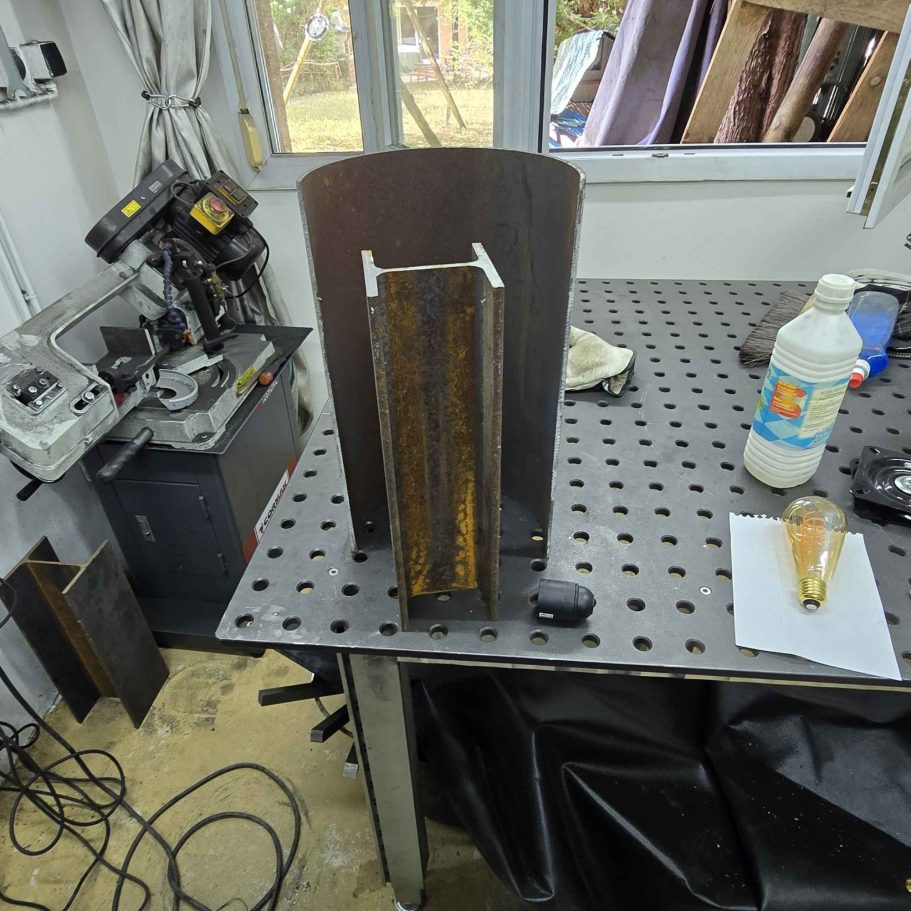
Early assembly experiments with curved steel and an H-shaped beam
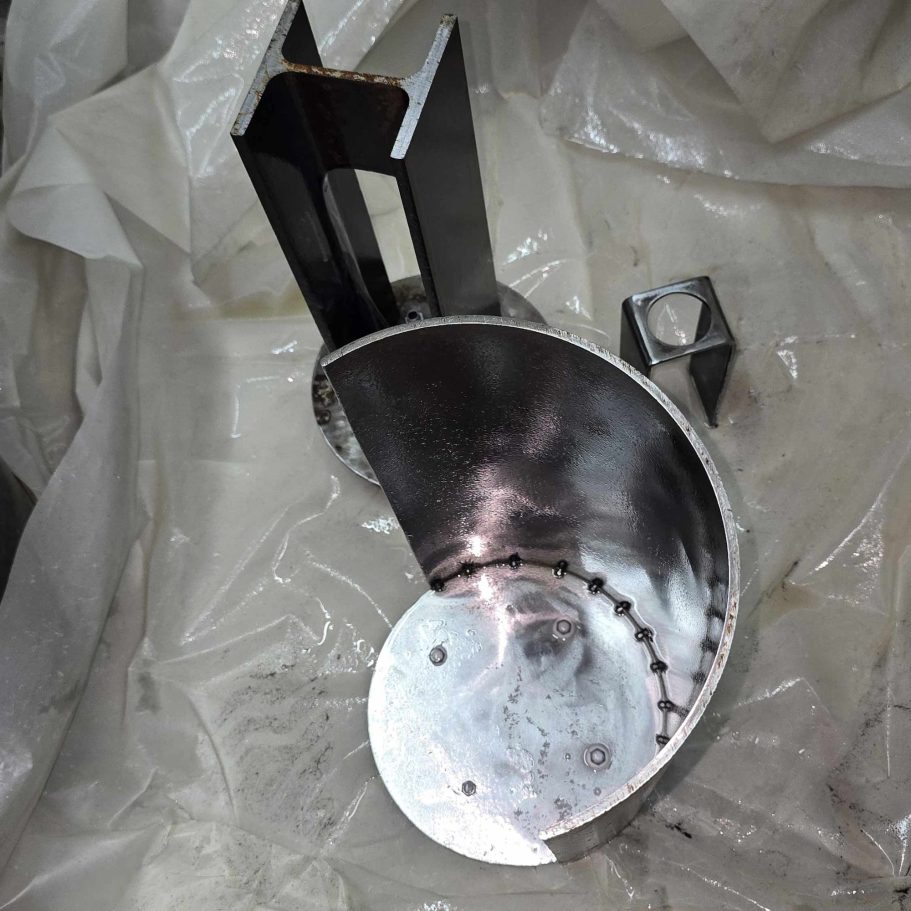
Disassembling the steel sculpture before the oxidation process
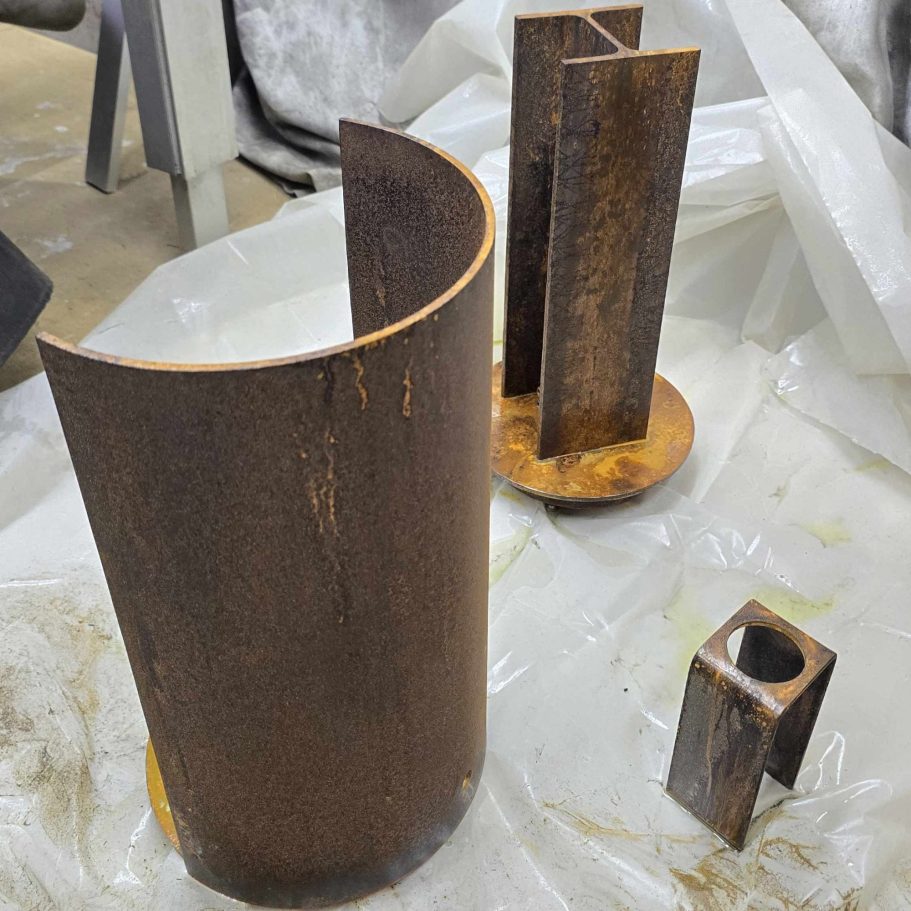
Controlled oxidation gradually transforms the steel surface
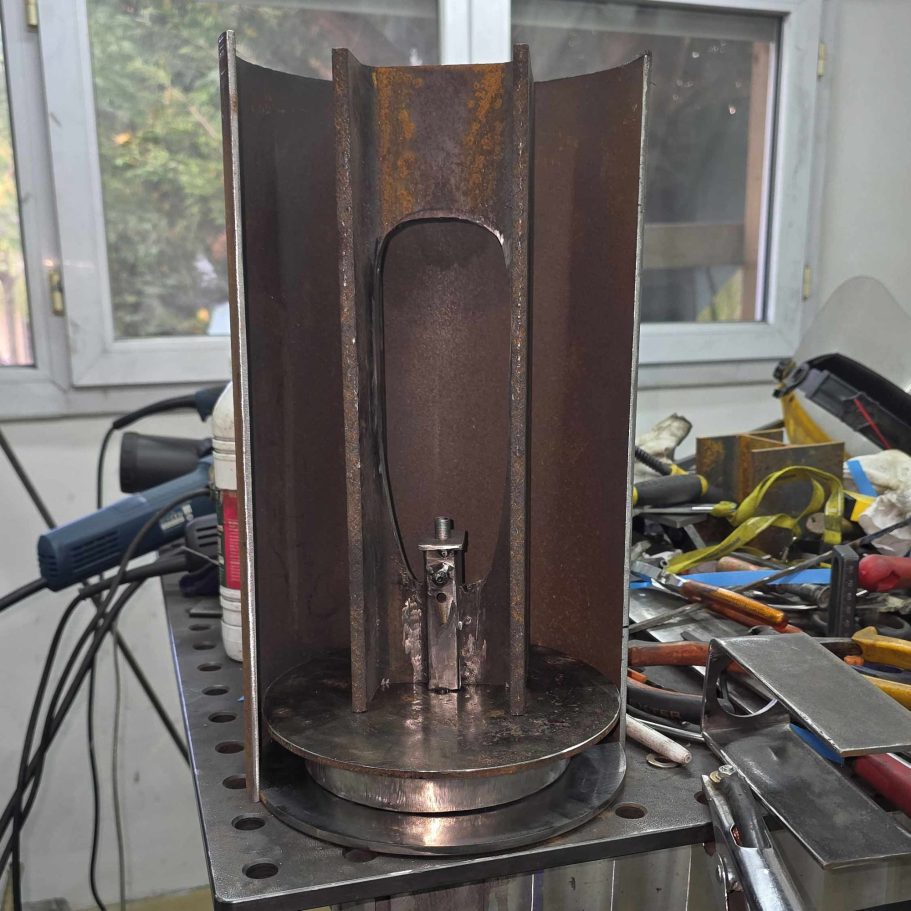
Reassembly, adjustments and finishing after steel oxidation
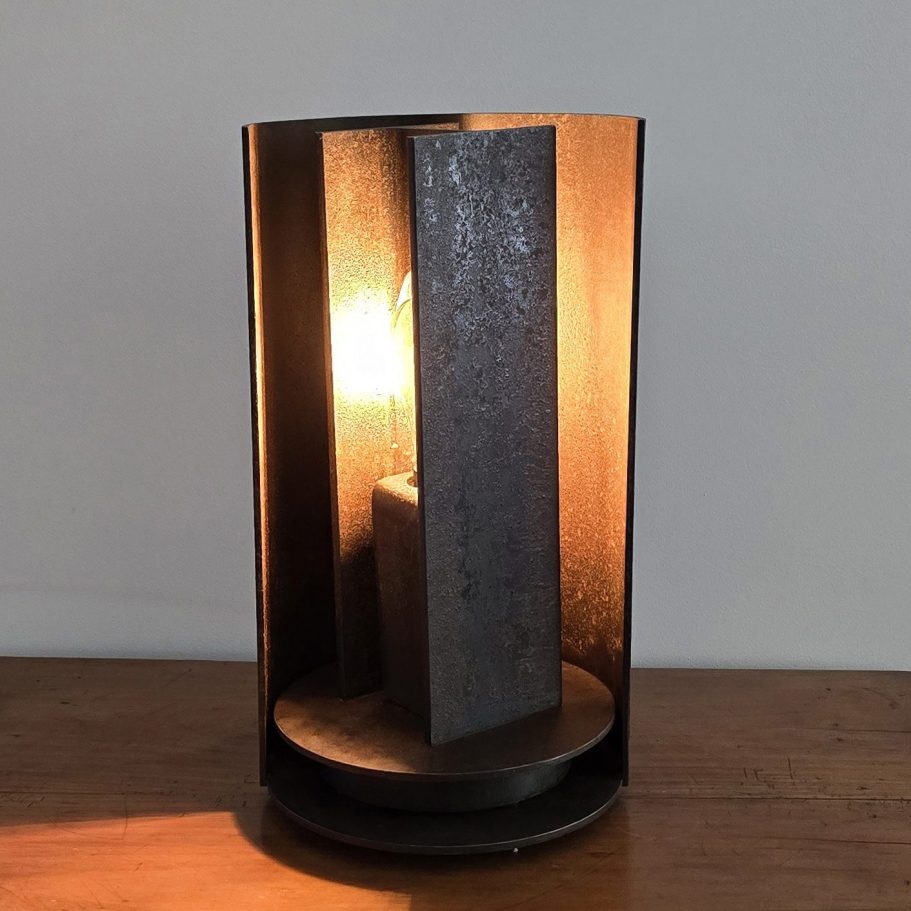
Sype 019 – Veil of Light, the finished oxidized steel light sculpture
The Creative Process: Exploring Form Without Forcing It
After creating Sype 021 – Silent Orbits, a contemporary steel floor lamp, the idea of developing a smaller light sculpture using the same visual language of circles emerged naturally.
The starting point remained the same: circular steel forms, intersecting volumes and light finding its place within the structure.
I explored several directions. The circles moved closer together, drifted apart and changed orientation. A central sphere appeared, then disappeared. The proportions evolved with each experiment. Every version revealed something new, yet none produced that unmistakable feeling: this is the one.
This uncertainty is an essential part of my creative process.
Sometimes a sculptural form emerges almost immediately. An idea arrives, the desire to build follows, and everything seems to fall naturally into place.
At other times, the exploration becomes more demanding. The structure works, the proportions seem right, but something is missing: a certain tension, a visual balance or the excitement that makes me want to take the sculpture further.
When that happens, I prefer to stop rather than force a solution.
Steel allows this freedom. A construction can remain in the workshop for days or even weeks, waiting to be reconsidered from another angle, disassembled, modified or simply set aside. Time becomes part of the artistic process.
These different experiments inspired by Sype 021 reveal the development of my approach to geometric steel sculpture and sculptural lighting.
They are not necessarily failures or unfinished stages of an artwork destined to exist. They are explorations, possible directions and sometimes creative dead ends that gradually help me understand what I am searching for.
In handcrafted lighting and contemporary metal sculpture, technical precision alone is never enough. The final form must also carry a sense of purpose, balance and emotion.
Ultimately, the real challenge is not to make another lamp.
It is to discover the form that gives it a reason to exist.
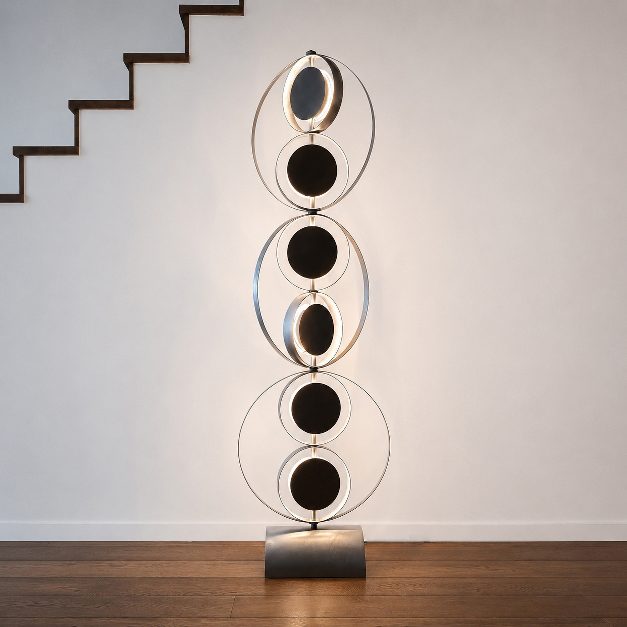
Sype 021 – Silent Orbits, the steel light sculpture that inspired this exploration
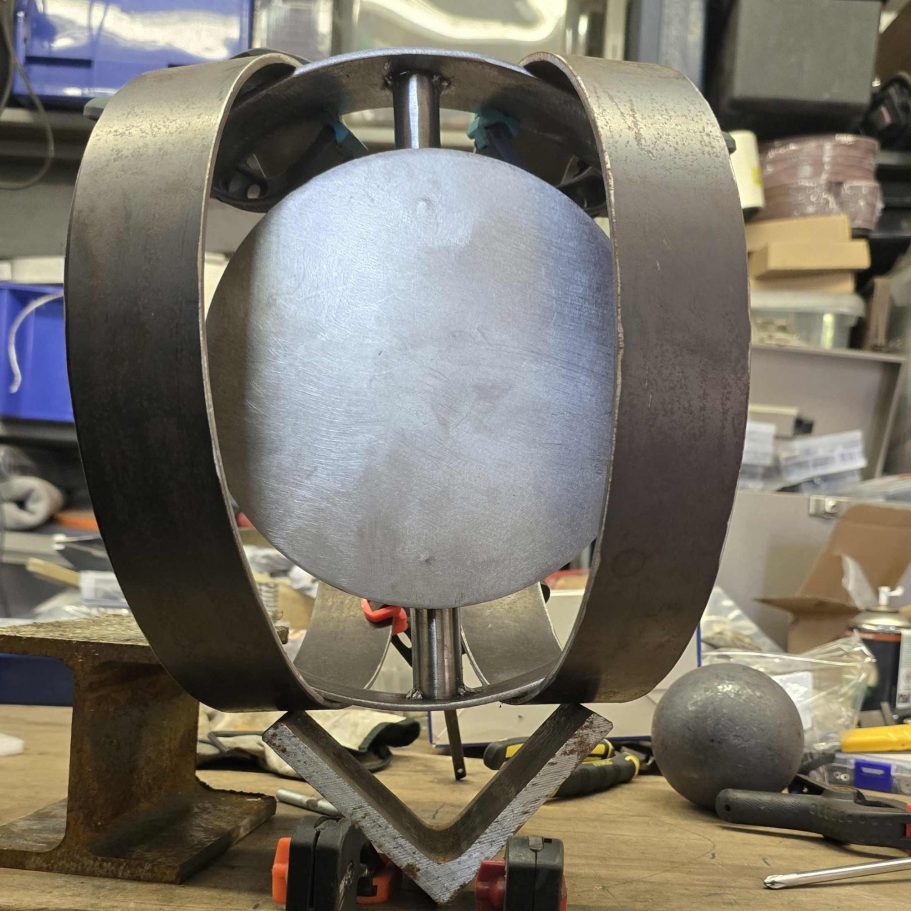
Early experiments with circular steel forms and a central sphere
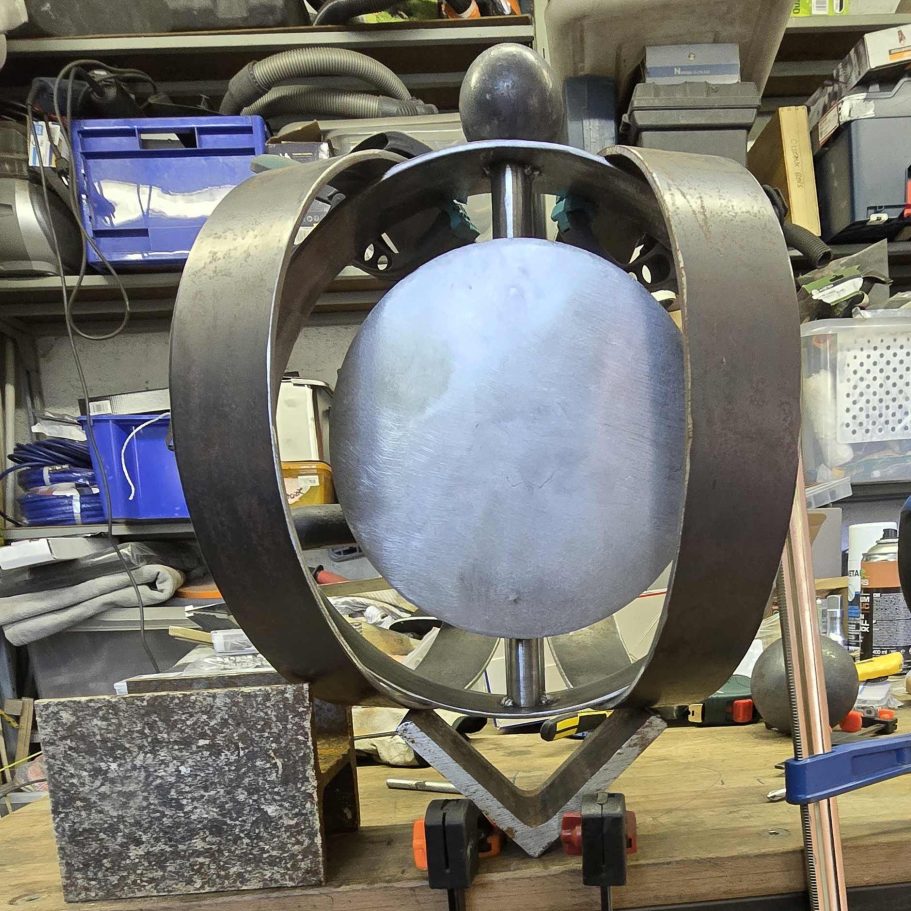
Exploring proportions and visual balance in a geometric steel sculpture
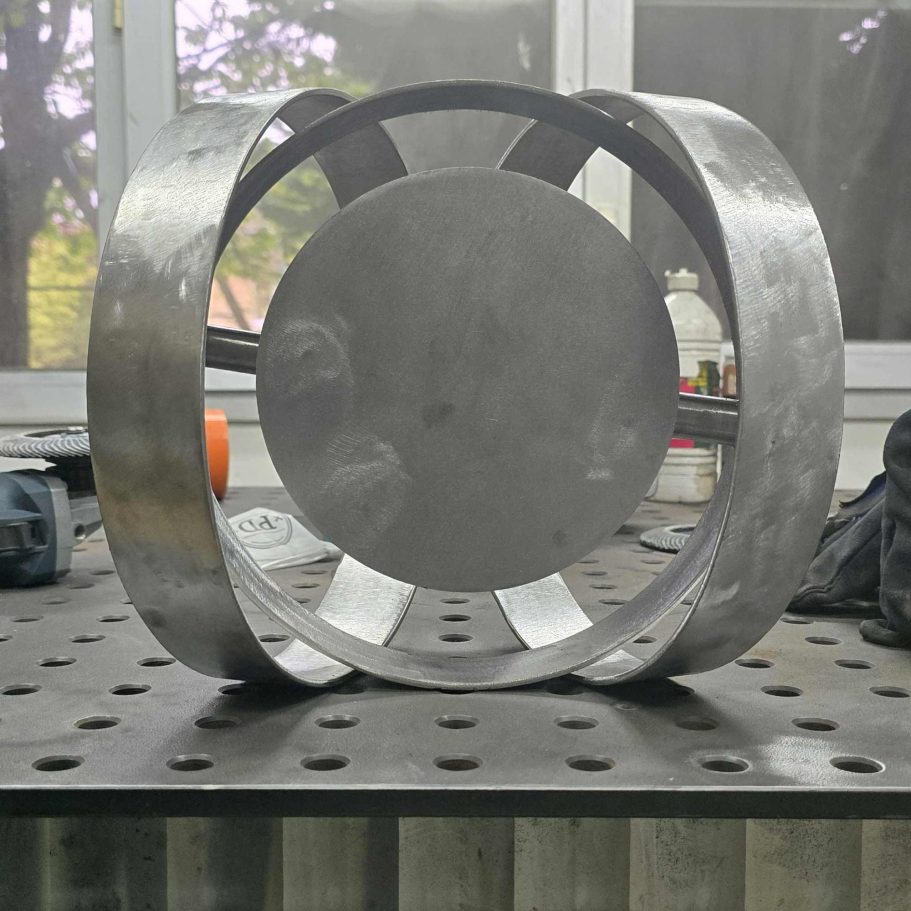
Simplifying the steel circles around a central sculptural form
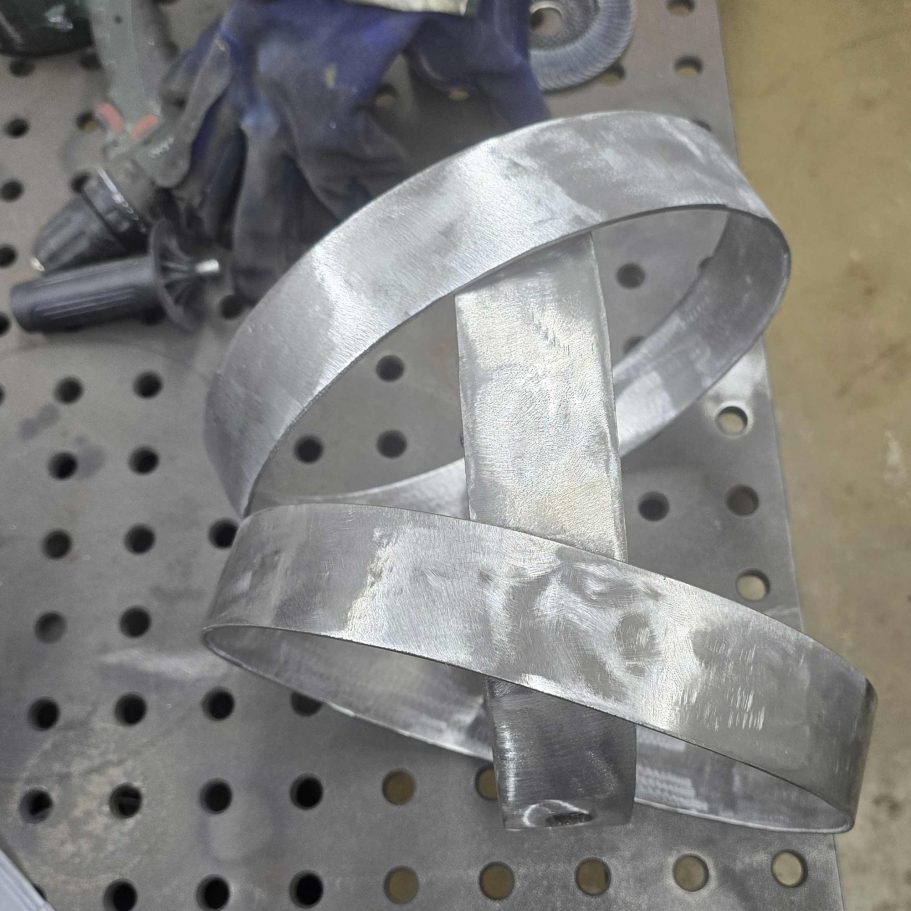
A freer sculptural direction beyond the original geometric design